Market crises, the logic of the big funds so you don't endure the chaos
The markets collapse because of global tensions and the instinctive reaction is to panic. But the big funds do the opposite. They read volatility, follow a protocol and turn the chaos into an opportunity, with defined risk.
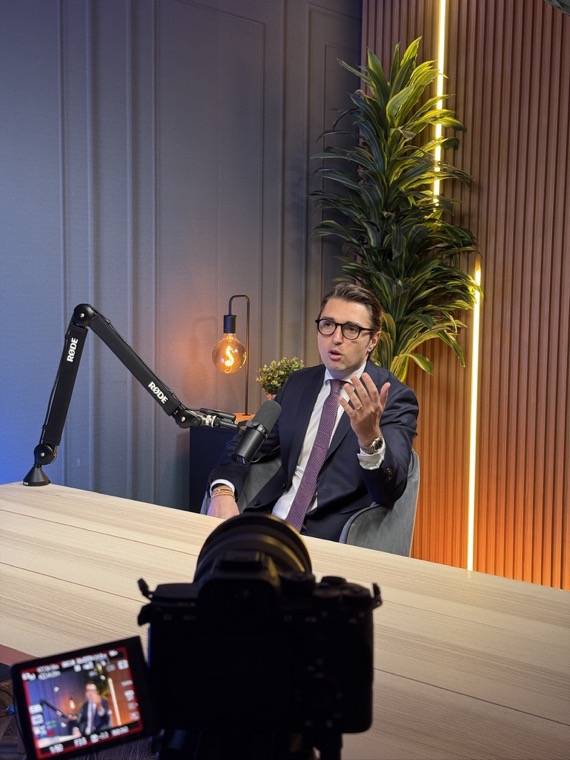
From the live session with Stefano Lokar Pignatari · Updated July 2026
The full recording of the live session · below you will find the guide drawn from it, point by point.
The problem isn't the crash, it's not seeing it coming
Most people think that the problem with a black swan is the crash itself. But let's do a simple piece of backwards reasoning.
If you knew 48 hours in advance that the markets were about to fall by 30%, would it still be a problem? Obviously not, it would become an opportunity.
The real issue, then, is not the crash. It is not knowing when it is about to arrive.
And here is the truth that few point out: the markets never go from calm to shock in a second. Before something big happens, certain dynamics start to change.
Volatility sends anomalous signs days, sometimes weeks, in advance. The problem is that most investors do not know where to look.
Volatility is not the enemy, it is the wave to surf
In our field a crisis has only one true protagonist: volatility. Do not necessarily read it as something negative.
It is not a threat to be endured. It is a wave to surf, and it is the heart of the whole Plutonis ecosystem.
Its most valuable feature is mean reversion, the tendency to always revert towards its historical average, around 19-20.
The VIX lives in a precise range: it has never gone below 9, nor above 80-85. When it explodes, as on 5 August 2024 at 65, sooner or later it comes back. That time it took just 24 hours.
A share can fail, oil during Covid ended up below zero. Volatility does not: sooner or later it comes back towards the average. That is what makes it a unique asset.
Volatility is the only raw material that never runs out on the markets.
The warning signs the market sends before the shock
Looking only at the VIX is not enough. In fact, those who stop there often do not even know the difference between VIX Index e VIX Future.
The first clue, free and within everyone's reach, you find on VIX Central and it concerns the shape of the curve.
- Curve in contango, the normal shape, synonymous with stability.
- Curve in backwardation, the anomalous, inverted shape, which happens only 12-13% of the time. When you see it stable for two or three days, it is an alarm.
A second simple reference point: the VIX above 30 is a very poor sign of calm, a very high danger level.
Then there are the VVIX, the skew, the put/call ratio. Useful ingredients, but on their own they do not say enough.
It is like carbonara: we all know the ingredients, but knowing how to cook them together is another matter. The value is not in the single figure, it is in reading them as a whole.
The real danger is you, not the market
There is an enemy that destroys more than the crash itself: emotion.
During Covid, managing around one billion dollars for a fund, I saw institutional clients pay in further millions to average down their losses, and others liquidate everything in panic when it no longer made any sense.
Averaging down a position that is going against you, hoping for the bounce, is one of the most dangerous moves. It is what leads to wiping out the account.
The difference between those who lost and those who held was not intelligence, nor even strategy alone. It was having a decision-making system based on data, not on the emotion of the moment.
Think of how many people are conned by those who boast of an indicator able to anticipate every crash. No such indicator exists. But the desire to have one says it all.
An ecosystem for every phase of volatility
A single tool is not enough, because the market has more than one face. You need an ecosystem that covers every phase.
- A system for when the market is calm, the Plutonis system.
- A system that anticipates the shock and puts you under cover.
- A system for riding high volatility in your favour.
The alert works like a traffic light. Green, you trade calmly. Amber, pay attention. Red, consider whether to stay out or apply hedges.
And there is a precise protocol to follow: from the first alert you stay at the window for 30-45 days, because that is the period in which, historically, the chaos is concentrated.
There is no need to predict the future. What you need is a plan for every scenario of volatility, knowing when to defend and when to attack.
Trading in the chaos with the loss defined in advance
In the chaos you do not improvise with a long or short CFD, nor with volatility futures: leverage and overnight costs eat everything up.
The Plutonis method does not bet on direction. The work is done on volatility with options, on statistical probabilities of success.
The logic is that of the house, or of an insurance company: options are sold and the premiums are collected, with a high probability on each individual trade.
The great advantage of options is that you can define the maximum loss before opening the position, and spread the risk across several levels.
Because investing is never a question of outcome. It is always and only a question of risk control. And the risks remain real, including the possible loss of capital.
Be careful though: even the soundest system has to be applied properly. Those who felt invincible, forgetting to break up their capital, paid dearly for events like 5 August.
The crises the system has already anticipated
This is not theory. This approach anticipated the exit ahead of the main recent shocks.
- Covid 2020, detected on 31 January, 21 days before the crash.
- Invasion of Ukraine, alert on 20 January 2022, over a month before.
- 5 August 2024, the explosion of volatility, anticipated on 24 July.
- Trump tariffs, exit on 3 April 2025, two days before.
- Middle East crisis, detected about a month before.
There are also false alarms, missiles that pass overhead without hitting. But an alarm that sometimes rings for nothing is still preferable to not having one at all.
The question is simple: in the next crisis do you want to be the one who panics with the markets, or the one who already has a plan?
If you want to understand how to apply all this to your situation, a Plutonis tutor can help you build the educational path most suited to you.
Continue the path.
The institutional method in a crisis
How institutional investors operate when markets crash.
Read the guide → Video guideUnlock idle capital
The logic with which the big funds put capital to work.
Read the guide → The methodHow the Plutonis System works
The non-directional method, from start to finish.
Read the guide →Not just theory. Real people.
A method of his own, beyond the business
How he learned to manage his savings on his own, without it becoming a second job.
Protecting what he has built
From a long career as an executive to an extra income built with method.
Clear rules, at last
From many courses without a method to a repeatable protocol, applied on his own.
In the next crisis, choose to have a plan, not panic
Understanding is the first step. The second is finding out whether the method suits your profile. It takes a few minutes: we read your situation and, if you are not suited, we tell you honestly. No pressure, no commitment.
Do you want the full picture of the method? Read How the Plutonis System works. Educational content, not financial advice.